
Last Updated: September 16, 2026
1. Battery Health and Cold Cranking Amps Requirements
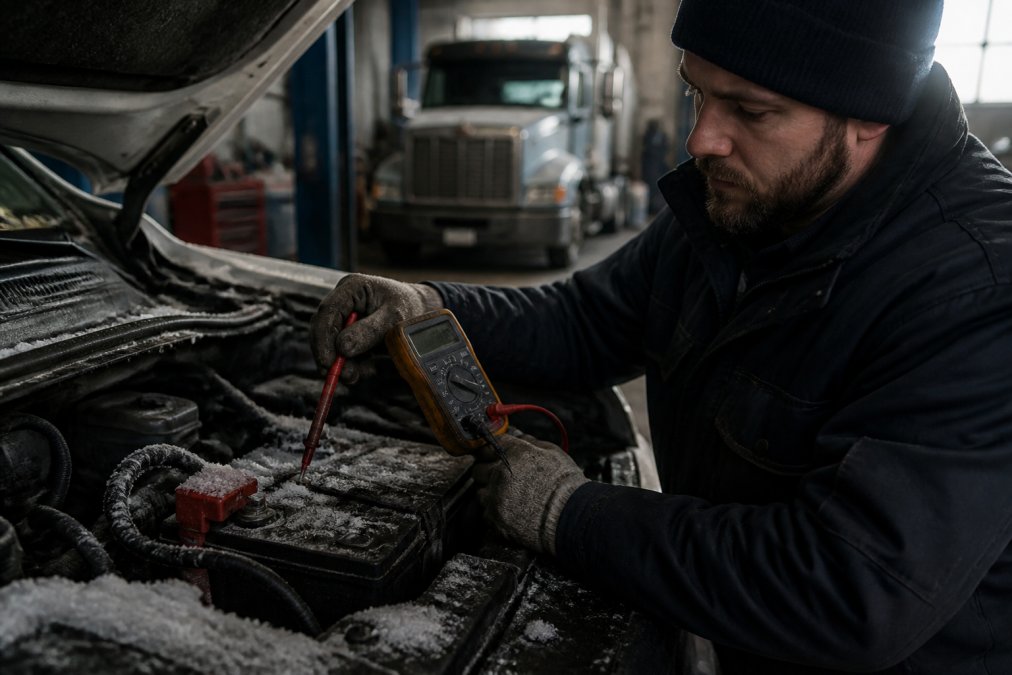
A battery that starts a truck in October can fail on a January morning, because cold weather thickens engine oil and slows the battery's chemical reaction, making truck maintenance a winter priority.
2. Diesel Fuel Anti-Gel Additives and Winterized Fuel
Diesel clouds and gels in cold weather, clogging filters and stalling the engine.
Winterized fuel is blended for colder months, but a truck that fuels warm and drives into a cold snap can still gel.
3. Winter Emergency Kit for Truck Drivers
A winter emergency kit keeps a driver safe and warm if the truck breaks down or gets stranded.
4. Brake System Inspection Before Winter
Cold weather stresses air brakes, and moisture in the air lines can freeze and disable them, so truck maintenance before winter is essential.
5. Engine Oil and Fluid Viscosity
Engine oil thickens in the cold, making the engine harder to turn over.
Use synthetic oil blended for winter viscosity, check coolant concentration to prevent a cracked block, and top off all fluids before the cold sets in.
6. Tire Pressure and Tread Depth Checks
Tire pressure drops as temperatures fall, reducing traction and fuel economy. Check tread depth and inflate to the recommended pressure for the load.
7. Undercarriage Wash and Corrosion Prevention
Road salt speeds up rust on the frame, brake lines, and chassis. An undercarriage wash removes salt and grime, and chassis lubrication protects moving parts.
8. Driver Health and Safety in Extreme Cold
Cold weather raises the risk of hypothermia and frostbite for drivers who spend hours outside the cab.
9. Telematics and Fleet Monitoring for Winter
Telematics systems track battery voltage, tire pressure, and fault codes in real time, letting a manager spot a weak battery or low tire before it becomes a roadside breakdown.
10. Post-Winter Inspection Checklist
Once the cold breaks, inspect for rust, worn brake components, cracked belts, and a weakened battery so problems don't carry into spring.
| Check | Why It Matters | When to Do It |
|---|---|---|
| Battery load test | Prevents cold-start failure | Before first freeze |
| Anti-gel additive | Stops fuel gelling | Before each cold snap |
| Emergency kit | Keeps driver safe | Start of winter |
| Undercarriage wash | Removes road salt | After storms |
| Air brake inspection | Prevents frozen brakes | Before winter |
| Post-winter inspection | Catches winter damage | Early spring |
Winter punishes a truck that has not been prepared, and the fixes are far cheaper than a roadside breakdown in freezing weather.
At Doug Cupples, our certified technicians use genuine GM parts for maintenance and repairs, and our service department can inspect your battery, brakes, and fluids before the cold arrives.
Ask for Doug Cupples at 641-521-8725 to schedule service and keep your truck ready for winter.
"What good is it for someone to gain the whole world, yet forfeit their soul?"
DougCupples content is educational market commentary, not individualized financial or purchasing advice. Figures reflect the reporting dates shown and move quickly — confirm current numbers before you act on them.
Before you use this information
Auto market guidance works best when it is tied to a real vehicle, a real quote, and a real deadline.
If this article changes how you are thinking about a purchase, save the listing, the VIN, the mileage, the asking price, and the city where the vehicle is advertised.
For a trade-in question, write down your payoff amount, the vehicle condition, and any independent appraisal you already have.
For a financing question, compare the APR, the term, the down payment, the total amount financed, and the full out-the-door number.
Those details make it much easier to separate a fair Central Iowa deal from a monthly payment that only looks comfortable because the loan got longer.
When a price looks appealing, check whether the discount is attached to a required add-on, a longer term, a higher rate, or a trade allowance that moved money from one line to another.
When a vehicle looks expensive, check local supply before you walk away; a scarce trim can hold its number while a similar model across town has room to move.
The practical move is to slow the deal down long enough to compare the total cost, not just the headline price or the payment printed in large type.
Doug can help turn those details into better questions for the salesperson, the sales manager, or the finance office before you sign.
That is especially useful when the decision is close, because small changes in rate, term, fees, trade allowance, or timing can move the real cost by hundreds or thousands of dollars.
If you are shopping around Newton, Des Moines, or the surrounding Central Iowa market, local inventory and dealer supply matter more than a national headline.
- Ask for the out-the-door price in writing before you discuss payment.
- Compare similar vehicles within driving distance, not national averages alone.
- Check how long the specific VIN has been in stock.
- Confirm whether each fee is required by the state, the lender, or the dealership.